
Join Us on October 27th to Celebrate Lane Library’s 120th Anniversary!
Come celebrate 120 years of Lane Medical Library on Tuesday, October 27th, from 1:20 to 4:00 pm. We’ll have cupcakes and cookies at the library!
Our History
- 1882: Lane traces its roots to Cooper Medical College.
- 1906: Thanks to a generous donation from Pauline and Levi Cooper Lane, the Directors of Cooper Medical College formally established the Levi Cooper Lane Library of Medicine and Surgery on August 29th.
- 1908: On August 10th, the Board of Directors voted to transfer all Cooper Medical College properties to Stanford University. With 35,000 volumes, Lane was the largest medical library west of Chicago.
- 1912: Lane moves to a new Beaux-Arts building designed by architect Albert Pissis at Sacramento and Webster Streets in San Francisco.
- 1959: After more than 50 years in San Francisco, Lane, along with Stanford’s entire School of Medicine and clinics, moved to its current home designed by Edward Durrell Stone. By 1990, Lane’s collections had grown to full shelving capacity, and some collections were located in the Stanford Band Shak.
- 1987: Lane Medical Library introduces its first online database and public catalog system, called LOIS (Lane Online Information System).
- 1992: Lane librarians teach Computers in Medical Education (CIME) courses for all incoming medical students and provide computer access to the first online digital journal to begin its shift to a mostly digital library.
- 1994: The library launches its first website.
- 2004: Lane participates in the Google Books Library Project along with the rest of Stanford Libraries to scan over 3 million books. Over time, Lane’s online databases, eBook, and eJournal collections grow, so Lane can repurpose bookshelf space for people spaces, keeping Lane a community-centered place to learn and gather. This also enabled a distributed library model: physical volumes in high-density off-site storage, 24/7 access to the digital library of knowledge via the website, and distributed study spaces in Lane Library and the new medical education building.
- 2010: Grand opening of the Li Ka Shing Center for Learning and Knowledge featuring 8 new study rooms, a student lounge, and collaborative learning spaces for graduate, medical, and PA students on the 4th floor. Dedication of the Stanford Medical Narratives project, commissioned in 2008, features illustrations and narrative quotes from Lane’s Medical History Center. This permanent public art installation features black marble benches highlighting Stanford Medicine’s milestones.
- 2017: Lane Medical Library partners with the BioSci Careers Center to manage a collection of print and digital books to support career path exploration.
- 2020: Lane Library offers curbside pickup for circulating books and journal articles during the pandemic shutdown. The D-CORE collection is established through a donation from the ADVANCE Summer Institute and made available to the Stanford community at the Diversity Center of Representation and Empowerment (D-CORE).
- 2021: Lane resumes open hours 7 days/week.
- 2025: Medical Humanities collection established with a generous gift from Audrey Shafer, Founder, Stanford Medical Humanities and the Arts/Medicine and the Muse.
Lane Today
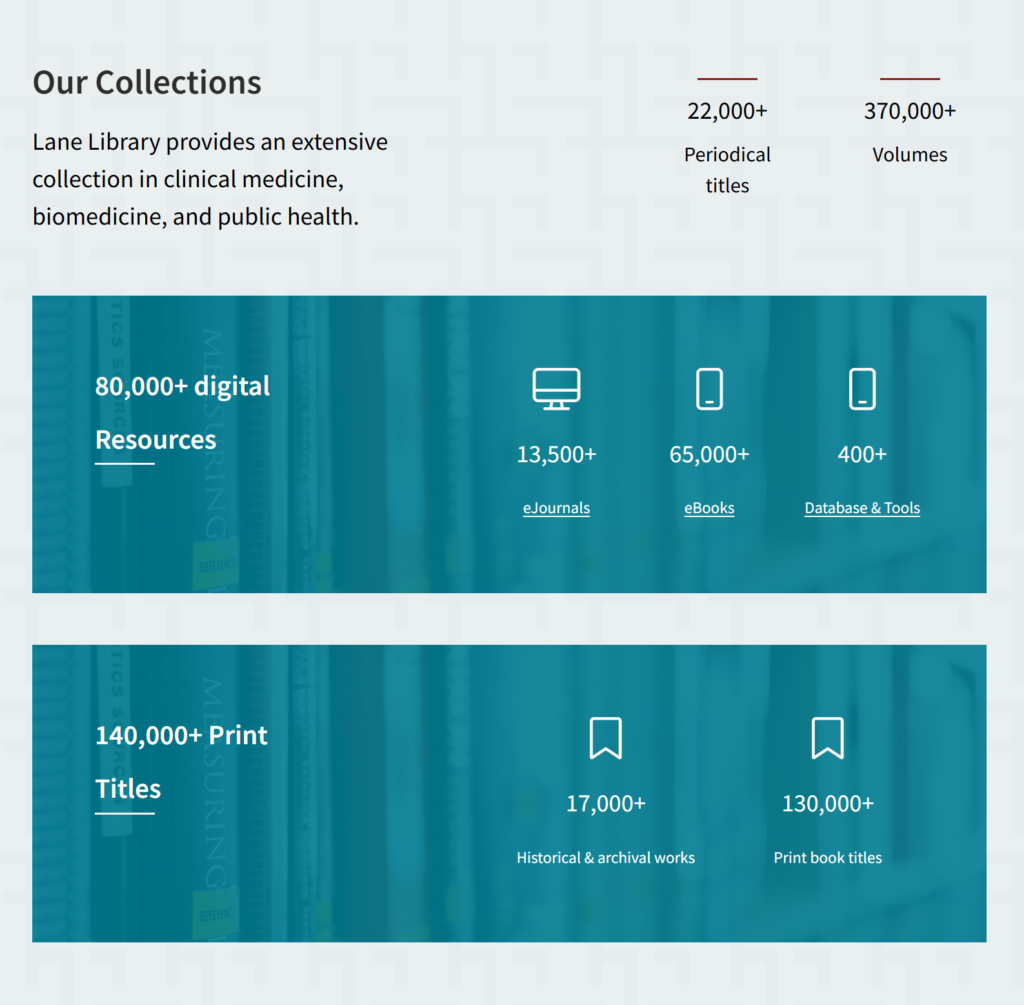
Located in the heart of the medical center, Lane is the library of record for Stanford Medicine. We offer an extensive collection in clinical medicine, biomedicine, medical humanities, and public health. Lane librarians and staff directly support Stanford Medicine’s research, clinical, and education community to turn these collections into new knowledge.
Visit Lane’s website to access this wealth of resources, including expertly curated specialty and research guides and links to a calendar of our upcoming online and in-person classes.
As we mark our 120th anniversary, we’re looking ahead to how Lane will continue to evolve and support biomedical knowledge discovery as we plan for our new library and knowledge exploration center space.