Covidence in the Age of AI: Why Human-Guided Evidence Synthesis Still Matters
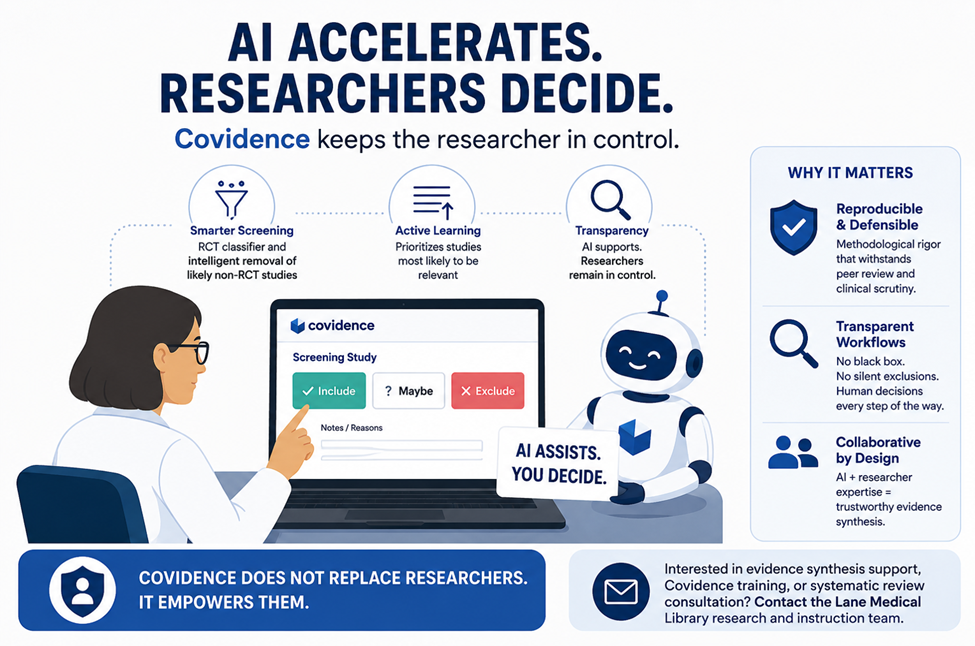
AI tools for evidence synthesis are EVERYWHERE right now. Platforms like Elicit, ASReview, and many others are rapidly changing how researchers conduct all types of literature reviews and evidence synthesis. Many of these tools look impressive and are enticing for busy researchers. However, amid AI adoption and acceleration, Covidence continues to stand out for a simple reason: it keeps the researcher in control. This is why Covidence remains one of the gold standards for systematic and scoping reviews in academic medicine and evidence synthesis workflows. See Lane Medical Library’s new library guide for a deeper look at how Covidence compares to other AI-powered evidence synthesis tools.
How to Access Covidence
Lane Medical Library offers free registration to Stanford researchers and to co-researchers invited by a Stanford affiliate. Simply complete the invitation form using your Stanford or Stanford Hospital-affiliated email address. A Lane librarian can also help build a screening profile and invite your research team to the project. Lane Library offers classes on using Covidence, and our instruction librarians are here to help with the Covidence workflow from start to finish. Researchers interested in evidence synthesis support, Covidence training, or systematic review consultation can join our June 3rd Covidence class or reach out to schedule a 1-1 consultation.
More about Covidence
Covidence uses machine learning to support researchers with features such as the Cochrane-developed Randomized Controlled Trials classifier and active-learning–based relevance sorting. Its active learning model analyzes reviewer screening behavior and prioritizes studies that are most likely to be relevant first. Covidence does not silently exclude studies or make final screening decisions on behalf of the researcher. Human reviewers remain in control of inclusion, exclusion, conflict resolution, and data extraction decisions throughout the process.
Evidence synthesis is not just about speed, as many emerging AI evidence synthesis products would have you believe. It is about reproducibility and transparent workflows that can withstand peer review with Prisma guidelines intact and clinical scrutiny necessary for publication. Covidence’s approach reflects what responsible AI integration in research should look like, assistive rather than fully automated.